

One of the ways we fund the podcast is through affiliate links. If you purchase these items through our links, we make a commission that goes towards podcast operations. This post, and all the posts here on our website, may contain such affiliate links. To directly support our work, please purchase from our links, download the app, & consider becoming a member.
Welcome to Episode 151 of That Shakespeare Life, the show that takes you behind the curtain and into the real life and history of William Shakespeare.
For Shakespeare’s entire lifetime, and many years prior, sanitation and cleanliness was misunderstood, sometimes feared, and certainly not well practiced in 16th C England. The sanitation of Shakespeare’s lifetime functions as an example of when technology did not continue to progress past the Romans, but instead, absolutely digressed to truly gross levels. Excrement was collected in chamber pots, or sometimes just in an open area, whenever someone happened to find the need to relieve themselves. Once collected, it would be disposed of by throwing it out the window and into the street below (It was not uncommon for passersby to be hit with the falling urine or feces if they weren’t careful).
In 1591, a godson of Elizabeth I, and a member of her royal court, proposed a new idea. Sir John Harington would write The Metamorphosis of Ajax (A jakes is slang term for a place to go to the bathroom) in which he included detailed engineering diagrams and instructions for applicable use on the first ever flush toilet in England.
Here today to tell us about the history of chamber pots in England, John Harington’s design, and how this revolutionary piece of technology was received during Shakespeare’s lifetime, is our guest, Bob Cromwell.
Subscribe
Itunes | Stitcher | TuneIn | GooglePlay | iHeartRadio
Watch the video version of this week’s episode on YouTube.
Click the image to go to the channel.

Access the video version of today’s show, along with documentary films and animated versions of Shakespeare’s plays as a Studio Insider on Patreon.

Bob Cromwell is the author of the article, The History of the Flush Toilet and lead historian at toilet-guru.com. Bob’s work has led him to document plumbing in 24 countries, through the Neolithic era to spacecraft and several writers and artists in addition to Shakespeare. Bob holds a PhD, and has worked as a consultant for the Folger Shakespeare Library. Find more about Bob in the show notes for today’s episode
In this episode, I’ll be asking Bob Cromwell about :
- When an Elizabethan used a chamber pot, was this an item they kept in their homes or did they take it with them when they travelled as well?
- In Henry IV part 1 Act II Scene 1, the Second Carrier speaks a line saying that if they aren’t provided a jordan (which is a slang term for chamber pot), then they will use the chimney for their bathroom. Bob, was this a common practice for men to urinate in the fireplace of a home?
- While the book, Metamorphosis of Ajax, was perhaps intentionally an attacking allegory against Robert Dudley at the time it was written, the design presented included engineering diagrams down to a minutia of detail, illustrations of which we will include in today’s show notes. When we look at the drawings, it does appear that this flush toilet could be functional. Bob, was this design for a flush toilet actually installed at Harington’s home, as the book claims?
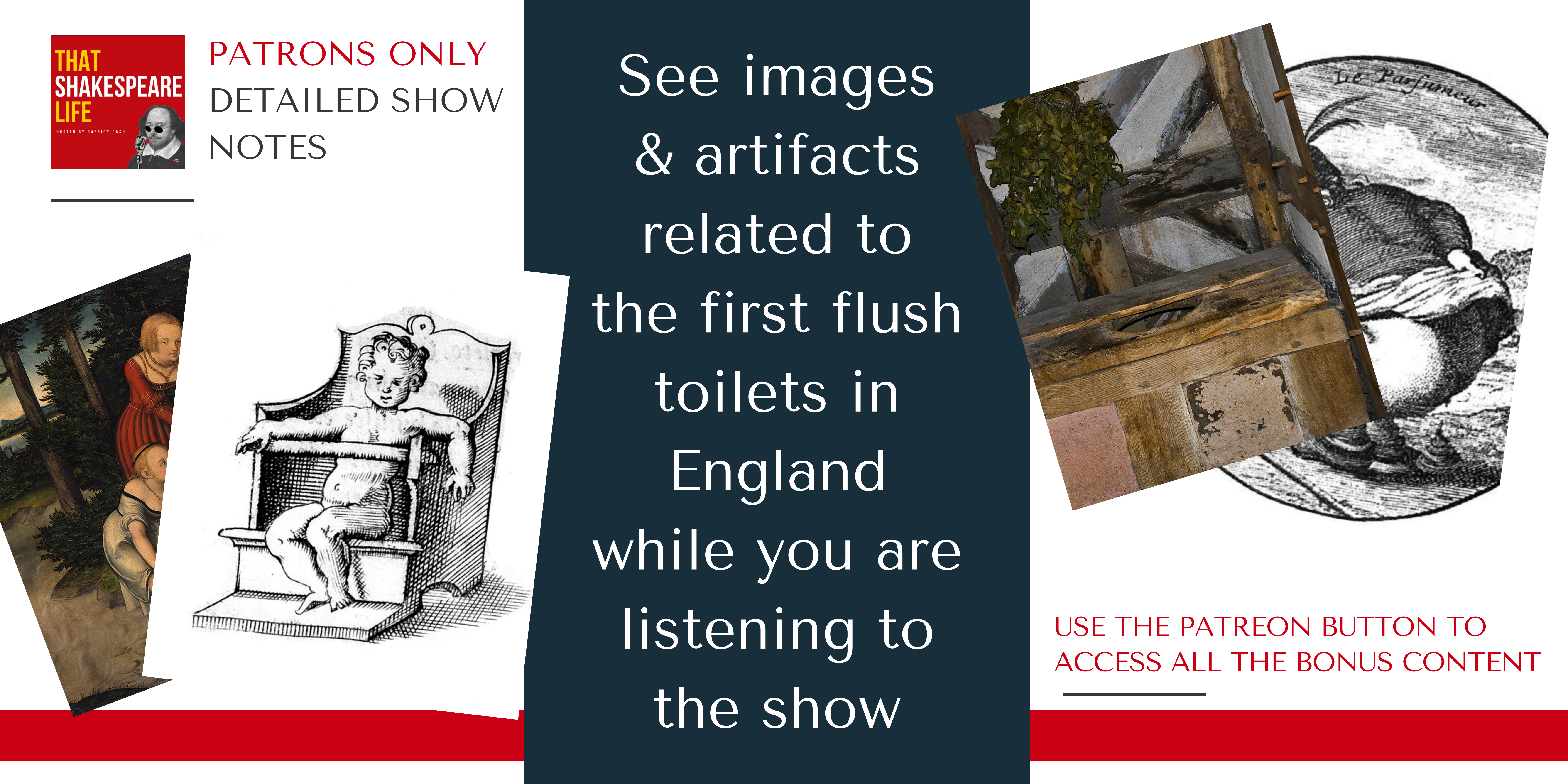
What’s Inside For This Episode:
- 1530 Chamberpot
- Painting featuring a 1610 urine flask
- a 1650 Close Stool (commode) similar to what Henry VIII would have used
- Portrait of John Harington, who invented the flush toilet
- Diagram of an Ajax flushing system, from 1596
- surviving 16th century toilet
- 16th century painting of Bathsheba in her bath
- 1577 woodcut of a baby sitting on a toilet
- 16th century illustration of a man going to the bathroom (defication).
- Illustration of Richmond Palace, where the first flush toilet was installed for Queen Elizabeth I
Resources Recommended by Bob Cromwell
The edited volume of Why James Should be the Next King
Orlando Furioso, the original is out there on Project Gutenburg but they started making available things from the 1800s when people were more squeamish. If you want a copy that leaves the original content, you’ll need harington’s copy
Nugæ Antiquæ is a compilation of various writings by both
father and son. The sonnets the father wrote to Isabella while still married to Etheldreda, and lots of letters by the son, including the simply amazing and hilarious description of a drunken multi-day party he attended along with King James and his brother-in-law King Christian of Denmark. Both were heavy drinkers and most of their courtiers couldn’t keep up. By the end, neither could the kings. This specific page is the start of that story:
https://archive.org/details/nugantiqubeinga03harigoog/page/n374/mode/2up
That’s an 1804 reprint in the NYPL collection.
“The Harington Family” by Ian Grimble, 1957, is a genealogy that goes back at least to the 1200s, and contains more than I’ve seen anywhere else about the two generations of interest to our conversation. 280 pages, 243 references. https://archive.org/details/haringtonfamily00grim/mode/2up
“An Apologie of Poetrie” was a prefix to his “Orlando Furioso” translation, Harington on Poetry, it’s available here: https://archive.org/details/ancientcritical00haslgoog/page/n155/mode/2up
Among John’s writings he used to solicit patrons:
A 4-volume set of his epigrams:
“The most elegant and witty epigrams of Sir Iohn Harrington, Knight, digested into foure bookes: three vvhereof neuer before published”
http://name.umdl.umich.edu/A02647.0001.001
“A Tract on the Succession to the Crowne” (When he saw Elizabeth’s death approaching, in which he argues to all of “Papists, Protestants, and Puritans” that James should
succeed her, of course James received a copy) https://archive.org/details/cu31924030506319/page/n9/mode/2up
“A Short View of the State of Ireland”, 1605:
https://archive.org/details/ashortviewstate01harigoog
“The Letters and Epigrams of Sir John Harington, together with ‘The Prayse of Private Life’”:
https://archive.org/details/lettersepigramso00hari
“Regimen Sanitatis Salernitanum” or the “Health Regimen of the School of Salernum” (probably his last significant translation work) 1624 edition, shortly after his death, which seems to be the result of someone editing together different writer’s contributions:
https://www.gutenberg.org/files/24790/24790-h/nurture.html
1920 reprint with current notes:
http://books.google.com/books?id=FKs-AAAAYAAJ
And, of course, the Metamorphosis of Ajax:
http://books.google.com/books?id=xP5NAAAAcAAJ&printsec=frontcover
And that together with “An apology — Ulysses upon Ajax”, which purports to be a response but is likely also by him:
https://archive.org/details/McGillLibrary-osl_metamorphosis-ajax_h2815m1814-19673/mode/2up
Orlando Furioso in the original:
http://www.gutenberg.org/ebooks/3747
There are free online English versions, but they’re from the 1800s and translators simply left out what they saw as the dirty parts. Harrington’s translation was in print at least into the 1960s. In the 1970s current translations began to appear. Now, of course, with Amazon and print-on-demand, you can buy through Amazon the result of printing and binding public-domain content found at Google Books, archive.org, and elsewhere. And so you could claim that his translation is still in print, although with an obvious asterix. Most books about toilets and related topics are rather lowbrow, but exceptions include:
“Between two stools: Scatology and its representations in English literature,
Chaucer to Swift” includes Shakespeare. It’s by a reader in Renaissance
Literature at Nottingham Trent University, published by Manchester
University Press.
As for the 19th century popularization of what we see as modern plumbing, the US experience is covered by “All the Modern Conveniences: American Household Plumbing, 1840-1890″.
“Bogs, Baths and Basins” is much more focused on Britain.
Shakespeare connected but on a very different topic: I have recently been recommending “The Woman Who Smashed Codes”, a biography of Elizebeth Friedman. She met her husband William when they were assigned to a project attempting to prove the Baconian authorship of Shakespeare’s work. They left to do cryptanalysis for the US Government, the book makes it clear that she was the better cryptanalyst of the pair.
While I was working at the Folger, they had a special exhibit on the cryptography of Shakespeare’s time. After the Friedmans retired they finished “The Shakespearean Ciphers Examined”, a merciless beat-down of crackpot theories and the psychological reasons people perpetuate them. It’s a free download:
https://www.marshallfoundation.org/library/digital-archive/shakespearean-ciphers-examined/
This text is from an email this week’s guest sent to That Shakespeare Life listeners. The “I” is from Bob Cromwell. If you find the information he sent over useful, please post him a thank you in the comments.
Comment and Share
Please consider rating the podcast with 5 stars and leaving a one- or two-sentence review in iTunes or on Stitcher. Rating the podcast helps tremendously with bringing the podcast to the attention of others. Please support the show by leaving your feedback. If you know someone you think would love to learn about the life of William Shakespeare, please spread the word by using the share buttons on this page.
And remember: In order to really know William Shakespeare, you have to go behind the curtain, and into That Shakespeare Life.
